
Thursday, August 11, 2016
Oklahoma's tax-credit scholarships are providing choices
Good article by Jessica Misun in the current MetroFamily Magazine.


Monday, August 8, 2016
Context missing in Oklahoma teacher pay debate
Economist Byron Schlomach writes that "a $5,000 pay raise in Oklahoma is the equivalent of a nearly $5,700 raise in the rest of the country."
Such an increase would raise teacher pay enough that on a cost-of-living-adjusted basis, only Texas would still outrank us among our nearby neighbors. We would have the 15th-highest average teacher pay, ahead of Connecticut, Rhode Island, California, and Massachusetts. Georgia would be the only Southern state besides Texas to outrank us in average teacher pay adjusted for cost of living.
A $4,000 pay raise would still see Oklahoma paying more than every neighboring state except Texas on a cost-of-living basis and see us continuing to outrank the states just mentioned. We would be 17th highest in adjusted teacher pay.
A $2,100 pay raise would see Oklahoma ranked 24th among the states in teacher pay with cost of living taken into account. We would move above Maryland, California, Massachusetts, and Missouri.
These are facts to be considered as Oklahomans contemplate raising teacher pay, whether the Legislature does this in a special session or we vote to do so in a referendum election. As the spouse of a teacher, a pay raise would be appreciated. But whatever is done, it should be an informed choice.Dr. Schlomach says Oklahoma's teacher pay currently ranks 30th, not 48th.
Thursday, August 4, 2016
Understanding the times: Oklahoma faith leaders working for parental choice in education
[Guest post by Patrick B. McGuigan]
Paul Abner is a minister of the Gospel—and more. For starters, he is the father of three delightful children. Jack, Julianna, and Cloe accompanied their father to a recent speaking engagement where he discussed educational options in the Sooner State, including his hopes for expansion of school choices to more parents and children.
He said in an interview that presently, after some 36 years in ordained ministry and more than two decades traveling through Oklahoma, he is focused on “bringing faith-based men and women into the public square to support school choice.”
A veteran organizer of worthy causes, Rev. Abner was drawn toward school choice activism by longtime civic activist Todd Pauley and began to work recently with Faith Leaders for Parental Empowerment in Education. After the practical work of developing logos and such things, he began to labor in the vineyards—reaching out to other ministers. It was in the course of that new work he “encountered many ministers who are also school teachers.”
While many exhibited a natural sympathy for educational choice, some of them have also challenged him—perhaps inevitably in a state like ours—among other things, sharing a fear that private school programs would beat local public school football teams.
At the other end of responses he has encountered, Abner shared nuggets from his conversations with people like Deborah—an inner-city Assembly of God preacher who says direct empowerment of parents and children to seek faith-based schooling options would be “the greatest thing that could happen for our kids.” She wants to break the generational curse of bad outcomes for minority students in urban schools.
Then, there’s his affiliation with Tony Miller of The Gate Church, a suburban congregation with 2,500 members who, Abner detailed, desires “to help the poor. To lift up people stuck in an educational rut.”
Abner continues with such outreach, dialogue, and direct action. Already he and colleagues leading the Faith Leaders group have brought hundreds of ministers into the cause. It is a natural extension, he believes part of a spiritual journey that flows from his original work as a youth minister.
Long ago, Abner bridged into professional affiliation with a national group, the Men and Women of Issachar. The Scriptural reference is to I Chronicles 12:32—to leaders who “understood the times, and understood what Israel should do.”
In the midst of his best years in such ventures, he got a call from a friend one day, inviting him to volunteer for the campaign of a political novice, a Southern Baptist youth minister working at the Falls Creek summer camp program. That was in 2009, and he agreed to help the long-shot campaign of a fellow named James Lankford.
In 2010, Lankford won a crowded Republican primary for the U.S. House seat that had been occupied by Mary Fallin, before her run for governor. The effort of which Abner was part was “the biggest outreach into faith community in Oklahoma political history.” After two good terms in the lower chamber of Congress, Lankford ran for the U.S. Senate. For that successful campaign Abner was one of his paid staff. Then, he was part of a conference for ministers held on a parallel track at the time of the Southern Republican Leadership Conference (SRLC) in Oklahoma City last year. Along the way, earlier this year, he found time to assist with the Franklin Graham prayer rally at the Oklahoma State Capitol, which drew some 6,000 people to join impassioned prayers for revival and moral renewal across America.
Paul Abner is a minister of the Gospel—and more. For starters, he is the father of three delightful children. Jack, Julianna, and Cloe accompanied their father to a recent speaking engagement where he discussed educational options in the Sooner State, including his hopes for expansion of school choices to more parents and children.
He said in an interview that presently, after some 36 years in ordained ministry and more than two decades traveling through Oklahoma, he is focused on “bringing faith-based men and women into the public square to support school choice.”
 |
| Paul Abner |
While many exhibited a natural sympathy for educational choice, some of them have also challenged him—perhaps inevitably in a state like ours—among other things, sharing a fear that private school programs would beat local public school football teams.
At the other end of responses he has encountered, Abner shared nuggets from his conversations with people like Deborah—an inner-city Assembly of God preacher who says direct empowerment of parents and children to seek faith-based schooling options would be “the greatest thing that could happen for our kids.” She wants to break the generational curse of bad outcomes for minority students in urban schools.
Then, there’s his affiliation with Tony Miller of The Gate Church, a suburban congregation with 2,500 members who, Abner detailed, desires “to help the poor. To lift up people stuck in an educational rut.”
Abner continues with such outreach, dialogue, and direct action. Already he and colleagues leading the Faith Leaders group have brought hundreds of ministers into the cause. It is a natural extension, he believes part of a spiritual journey that flows from his original work as a youth minister.
Long ago, Abner bridged into professional affiliation with a national group, the Men and Women of Issachar. The Scriptural reference is to I Chronicles 12:32—to leaders who “understood the times, and understood what Israel should do.”
In the midst of his best years in such ventures, he got a call from a friend one day, inviting him to volunteer for the campaign of a political novice, a Southern Baptist youth minister working at the Falls Creek summer camp program. That was in 2009, and he agreed to help the long-shot campaign of a fellow named James Lankford.
In 2010, Lankford won a crowded Republican primary for the U.S. House seat that had been occupied by Mary Fallin, before her run for governor. The effort of which Abner was part was “the biggest outreach into faith community in Oklahoma political history.” After two good terms in the lower chamber of Congress, Lankford ran for the U.S. Senate. For that successful campaign Abner was one of his paid staff. Then, he was part of a conference for ministers held on a parallel track at the time of the Southern Republican Leadership Conference (SRLC) in Oklahoma City last year. Along the way, earlier this year, he found time to assist with the Franklin Graham prayer rally at the Oklahoma State Capitol, which drew some 6,000 people to join impassioned prayers for revival and moral renewal across America.
Abner’s involvement in electoral politics was not a path he might have predicted for himself four decades ago, but as it unfolded, “I recognized the voice of God leading me to get more people of faith involved in the process of public policy.”
To be clear about Abner’s broad range of interests, he presently is supportive of the local public school bond issue for the Piedmont district. He has been encouraging support for the proposition in the faith community, and has discussed the issue with other leaders.
That thumbnail narrative brings us back to Abner’s current work with the faith leaders group, which includes Rev. Craig Eidson, who serves as pastor at a metro-area church. Eidson’s wife is a public school principal. In the course of their marriage, their children have been educated at home, in a private school, and in the public schools. At every stage, they have wanted, he said, “to do what’s best for the kids.”
Eidson reflects, “You hear that a lot—do what’s best for the kids. The question is if that’s what people are really for. Some people ask, ‘How can you say that and not be for creating smaller classes?’” Like most people who are knowledgeable about education, Eidson believes smaller class sizes and better teacher pay are worthy objectives. But, he has concluded since joining the faith leaders group, some people in education “just don’t want vouchers.” He has a different view: “Vouchers cannot hurt, and they are almost certain to help.”
To be clear about Abner’s broad range of interests, he presently is supportive of the local public school bond issue for the Piedmont district. He has been encouraging support for the proposition in the faith community, and has discussed the issue with other leaders.
 |
| Craig Eidson |
Eidson reflects, “You hear that a lot—do what’s best for the kids. The question is if that’s what people are really for. Some people ask, ‘How can you say that and not be for creating smaller classes?’” Like most people who are knowledgeable about education, Eidson believes smaller class sizes and better teacher pay are worthy objectives. But, he has concluded since joining the faith leaders group, some people in education “just don’t want vouchers.” He has a different view: “Vouchers cannot hurt, and they are almost certain to help.”
As he looks across America these days, Eidson says, he realizes that “we need God’s help. Allow parents to have total control of their children’s education. When we say we’re for what is best for the kids, do we really mean it? Or is it all about the agenda for public schools?"
The two faith-community leaders spoke at a special July 29 meeting of the Oklahoma School Choice Coalition, held at the Advance Center for Free Enterprise on the OCPA campus. Bill Price, a former U.S. attorney who now serves on the Oklahoma State Board of Education, honored Abner for his years of work as a leading state advocate for premarital abstinence, and his new role as an organizer of Faith Leaders for Parental Empowerment in Education. Price, an OCPA trustee who also serves as chairman of the Oklahoma School Choice Coalition, has advocated for public school excellence and increased educational options for several decades.
OCPA president Jonathan Small was unable to attend the meeting, but in a prepared statement he stressed the need not only for educational choice but also for a teacher pay hike. “Our preK-12 education system currently has plenty of money—$8.7 billion in total revenues last year, the most in state history,” he said. “But in a bloated system that employs more non-teachers than teachers, that money’s simply not going to the right place: take-home pay for the many excellent teachers who have earned a raise.”
 The July 29 meeting coincided with the July 31 birthday of the late Milton Friedman, a school-choice pioneer and one of the most honored economists of the 20th century. The session was more abbreviated than customary for the monthly meetings, as the event included a couple dozen children who are participating school choice programs in Oklahoma. And those youngsters were waiting to visit the ice cream truck parked outside the entrance of the Advance Center for Free Enterprise. When he kicked off the session, Price quipped that he had directed the speakers to keep their remarks focused because “I don’t want to be the guy standing between children and ice cream.”
 |
| Bill Price |
OCPA president Jonathan Small was unable to attend the meeting, but in a prepared statement he stressed the need not only for educational choice but also for a teacher pay hike. “Our preK-12 education system currently has plenty of money—$8.7 billion in total revenues last year, the most in state history,” he said. “But in a bloated system that employs more non-teachers than teachers, that money’s simply not going to the right place: take-home pay for the many excellent teachers who have earned a raise.”

Photo credits: Jay Chilton
Friday, July 29, 2016
Public education activist falsely accuses pastor
The Oklahoman recently took note of some disturbing activity on the Facebook page of Oklahoma Parents and Educators for Public Education.
One administrator of that page, activist Angela Clark Little, bluntly declared Republican state Senate candidate Paul Blair “hosted westboro (sic) at his church when they came to protest something in the Edmond area!!”
The Westboro Baptist Church (not affiliated with any Baptist denomination) is notorious for protesting soldiers' funerals, claiming those deaths are God's punishment for homosexuality. Due to its repugnant nature, the group gets extensive media coverage wherever it goes. There's no record of Blair hosting Westboro, and he strongly denies the claim: “We have never supported, engaged, or even met anyone associated with Westboro Baptist Church.”
When we asked Little for documentation, she said her post was based on another individual making the same claim elsewhere online.
Little has endorsed Blair's Democratic opponent, Kevin McDonald, and one of Blair's Republican primary opponents, Adam Pugh. But Little has indicated the Pugh endorsement is meant to boost the Democrat's chances, writing, "Strategically—we need Paul Blair out if we want Kevin McDonald to have a good chance in November."
A new chapter for Friedman
Milton Friedman helped revitalize Americans' interest in freedom, Jonathan Small writes today in The Journal Record. And his legacy foundation, the Friedman Foundation for Educational Choice, is now EdChoice:
Tuesday, July 26, 2016
Why did The Oklahoman publish an editorial in its news pages?
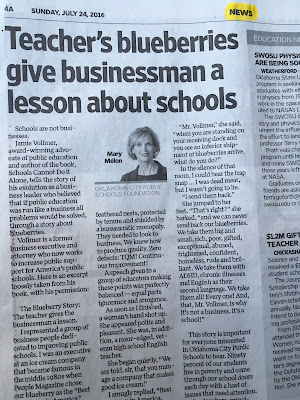
In an editorial which appeared on Sunday in The Oklahoman, Mary Mélon, the president and CEO of the Oklahoma City Public Schools Foundation, wrote about Jamie Vollmer, a former businessman who used to argue that schools should be run like a business but later changed his mind.
You can click on the link above to read her editorial. I'm not a big fan of the piece; I tend to agree with Joseph Bast that the blueberry story "doesn't live up to its billing." After all, "children are not 'raw material' in a production process. They and their parents are customers with legitimate expectations of being properly served."
We can certainly discuss the merits of the argument (as Trent England and I did on the radio this morning), but what puzzles me—and I suspect puzzles other readers—is why an editorial column is running in the news pages of The Oklahoman. The piece seems out of place on page 4A. Are other nonprofit executives going to be writing in the news pages now, or is it just Mrs. Mélon? Here's hoping the paper will provide an explanation.
Mary Mélon channels @jamievol's 'Schools Cannot Do It Alone' in her most recent editorial in @TheOklahoman. https://t.co/dJjiec51uh— Foundation for OKCPS (@FoundationOKCPS) July 25, 2016
You can click on the link above to read her editorial. I'm not a big fan of the piece; I tend to agree with Joseph Bast that the blueberry story "doesn't live up to its billing." After all, "children are not 'raw material' in a production process. They and their parents are customers with legitimate expectations of being properly served."
We can certainly discuss the merits of the argument (as Trent England and I did on the radio this morning), but what puzzles me—and I suspect puzzles other readers—is why an editorial column is running in the news pages of The Oklahoman. The piece seems out of place on page 4A. Are other nonprofit executives going to be writing in the news pages now, or is it just Mrs. Mélon? Here's hoping the paper will provide an explanation.

Monday, July 25, 2016
Debunking a brazen lie about ESAs
Jason Bedrick says this teachers’ union lobbyist should be embarrassed to peddle the easily discredited lie that there's no good way to control how parents spend ESA money.
Saturday, July 23, 2016
Are public schools like Soviet-era department stores?
Some in the public education community are displeased with the comment this week by Donald Trump, Jr. (courtesy of his speechwriter F.H. Buckley) that public schools are "like Soviet-era department stores that are run for the benefit of the clerks and not the customers."
But Mr. Trump is hardly the first person to make this sort of observation. Milton Friedman once described America’s public school system as “an island of socialism in a free-market sea.” Kevin Williamson, author of The Politically Incorrect Guide to Socialism, says “the public schools constitute one of the most popular instantiations of socialism in American life.” Indeed, he says, “in the United States, we have an education system that already is socialized to a greater extent than Lenin managed for Soviet agriculture.”
And it’s not just free-market economists and authors. Twenty-seven years ago today, American Federation for Teachers president Albert Shanker issued this wake-up call:
Defenders of the status quo can shriek at the mention of socialism and recommend business as usual (more taxes and spending, no reform). But it might be wiser to listen to constructive criticism and take it to heart. For as Mr. Shanker himself said, “business as usual in the public education system is going to put us out of business.”
But Mr. Trump is hardly the first person to make this sort of observation. Milton Friedman once described America’s public school system as “an island of socialism in a free-market sea.” Kevin Williamson, author of The Politically Incorrect Guide to Socialism, says “the public schools constitute one of the most popular instantiations of socialism in American life.” Indeed, he says, “in the United States, we have an education system that already is socialized to a greater extent than Lenin managed for Soviet agriculture.”
And it’s not just free-market economists and authors. Twenty-seven years ago today, American Federation for Teachers president Albert Shanker issued this wake-up call:
It’s time to admit that public education operates like a planned economy, a bureaucratic system in which everybody’s role is spelled out in advance and there are few incentives for innovation and productivity. It’s no surprise that our school system doesn’t improve: It more resembles the communist economy than our own market economy. …
We’ve been running our schools as planned economies for so long that the notion of using incentives to drive schools to change may strike some people as too radical—even though that’s the way we do it in every other sector of society. But no law of nature says public schools have to be run like state-owned factories or bureaucracies. If the Soviet Union can begin to accept the importance of incentives to productivity, it is time for people in public education to do the same.Many schools are failing to provide a quality education for at least some of their students and Oklahomans want alternatives. But as Williamson points out, “the public schools are not a random or inexplicable failure. They are a classical socialist failure, with massively misallocated resources, an ensconced bureaucratic class, and a needlessly impoverished client class.”
Defenders of the status quo can shriek at the mention of socialism and recommend business as usual (more taxes and spending, no reform). But it might be wiser to listen to constructive criticism and take it to heart. For as Mr. Shanker himself said, “business as usual in the public education system is going to put us out of business.”
[Cross-posted at OCPA]
Friday, July 22, 2016
PTA wants to create a new protected class for LGBTQ persons
At its annual convention this month, the National PTA adopted a resolution on the Recognition of Lesbian, Gay, Bisexual, Transgender and Queer/Questioning (LGBTQ) Individuals as a Protected Class. According to a press release, "National PTA and its constituent associations will advocate for legislation that explicitly recognizes LGBTQ as a protected group and addresses discrimination based upon sexual orientation, gender identity, and gender expression."
One of those constituent associations, the Oklahoma PTA, promptly did its part by retweeting this:

It's no secret that the transgender revolution has already made its way to Oklahoma. For example, Tulsa Public Schools—which recently had a gay pride flag flying outside of its headquarters—has trained teachers on the subject of "gender nonconformity" issues, including which bathrooms transgender children are allowed to use. And this was before the Obama Administration's bathroom decree (Commode Core, it's been dubbed), which essentially, in David French's words, enlisted "every single public educational institution in the country to implement the extreme edge of the sexual revolution."
If some of the Oklahoma PTA's Twitter posts are any indication, the organization appears to be on board with the revolution:


It is worth noting that not everyone believes it is wise to treat LGBTQ persons as a protected class. In a memorandum titled "Sexual Orientation and Gender Identity (SOGI) Laws Threaten Freedom," Heritage Foundation scholar Ryan T. Anderson explains:
It is worth noting that not everyone believes it is wise to treat LGBTQ persons as a protected class. In a memorandum titled "Sexual Orientation and Gender Identity (SOGI) Laws Threaten Freedom," Heritage Foundation scholar Ryan T. Anderson explains:
All citizens should oppose unjust discrimination, but sexual orientation and gender identity (SOGI) laws are not the way to achieve that goal. SOGI laws are neither necessary nor cost-free. They threaten fundamental First Amendment rights. They create new, subjective protected classes that will expose citizens to unwarranted liability. Furthermore, SOGI laws would increase government interference in labor, housing, and commercial markets in ways that could harm the economy. Yet SOGI’s damage is not only economic: It would further weaken the marriage culture and the freedom of citizens and their associations to affirm their religious or moral convictions, such as that marriage is the union of one man and one woman and that maleness and femaleness are not arbitrary constructs but objective ways of being human. SOGI laws would treat expressing these widely held beliefs in certain contexts as unlawful discrimination.
Thursday, July 21, 2016
'Oklahoma is something of a hothouse for teacher-sex stories'
Some national attention on Oklahoma educators behaving badly.
The profit motive is incompatible with public education? Nonsense.
Writing over at U.S. News & World Report, American Enterprise Institute fellow Ian Lindquist tackles the fallacious argument that "for-profit schools harbor a motive that makes them incapable of educating children—namely, a profit motive."
Adults who aim to make money cannot have children’s best interests at heart because they will look for opportunities to cut costs in an effort to pay shareholders rather than direct all available funds toward children’s education. The conflict of interest created by this profit motive renders for-profit schools incompatible with public education.
This is nonsense. Education is not the only sector that provides public goods. Indeed, there are many public goods handled by private companies: hospitals, prisons, and transportation systems operated by for-profit providers ensure public health, public safety, and public transportation. In none of those cases does profit motive necessarily dispose the company to abdicate its mission of serving the public. In these cases, companies’ ability to provide the best product possible is aligned with their ability to make money and pay their shareholders. Far from giving up their social missions to seek profit, they need to serve the public both to accomplish that mission and gain profit. Without mission, no profit. The mission is and must be primary.
The circumstances in the education sector do not nullify this logic. If an education company has a mission to provide excellent schooling for students, then it either fulfills its mission or it doesn’t. If it does, then it is a worthy contractor and its charter should be renewed; if it does not, then its charter should be revoked.
Read the whole thing here.
Subscribe to:
Posts (Atom)